You know that person who greets you, clips the bib around your neck, asks if you want the blanket, and then somehow hands the dentist every instrument before the dentist even asks for it? Most patients never learn their name. They assume that person is “the dentist’s helper” and leave it there.
Spend one morning shadowing that role and the assumption falls apart fast. So when people ask what do dental assistants do, the honest answer is that they run the practice from the inside. They prepare the room, capture the dental radiographs, manage infection control, calm the nervous patient in chair three, chart the procedure, and still find time to call the lab about a crown that hasn’t arrived.
This guide breaks down the real duties, the state rules nobody explains clearly, the pay, and the parts of the job that job descriptions leave out.
The Quick Answer First
Dental assistants prepare patients and operatories for treatment, assist the dentist during procedures through four-handed dentistry, take and process X-rays, sterilize instruments, take dental impressions, and handle records, scheduling, and billing.
That’s the short version. The long version depends heavily on three things: your state, your credentials, and whether you work in a general office or a specialty clinic.
The Two Halves of the Job
Almost every assistant splits their day between clinical work and office work. The ratio changes from practice to practice, but both sides show up.
Chairside duties (the clinical half)
This is the hands-on portion, and it’s the part most people picture.
- Seating and prepping patients, reviewing medical history, checking blood pressure and pulse
- Setting up the treatment room with the correct instruments and materials for that specific procedure
- Passing instruments and retracting the cheek and tongue so the dentist can actually see
- Running the high-volume evacuator and saliva ejector to keep the field dry
- Taking dental X-rays, placing the lead apron, positioning the sensor, checking image quality
- Taking impressions for crowns, night guards, whitening trays, and orthodontic retainers
- Making temporary crowns and mixing dental materials
- Running sterilization through the autoclave and turning over rooms between patients
- Giving post-operative instructions before the patient walks out
Administrative duties (the office half)
- Scheduling and confirming appointments
- Charting treatment and updating patient records
- Walking patients through treatment plans and cost estimates
- Submitting dental insurance claims and processing payments
- Ordering supplies and tracking inventory
- Coordinating with the dental lab on case turnaround
The U.S. Bureau of Labor Statistics lists a nearly identical duty set in its Occupational Outlook Handbook, including patient comfort, sterilization, instrument handling, suction, oral hygiene instruction, X-ray processing, recordkeeping, scheduling, and billing.
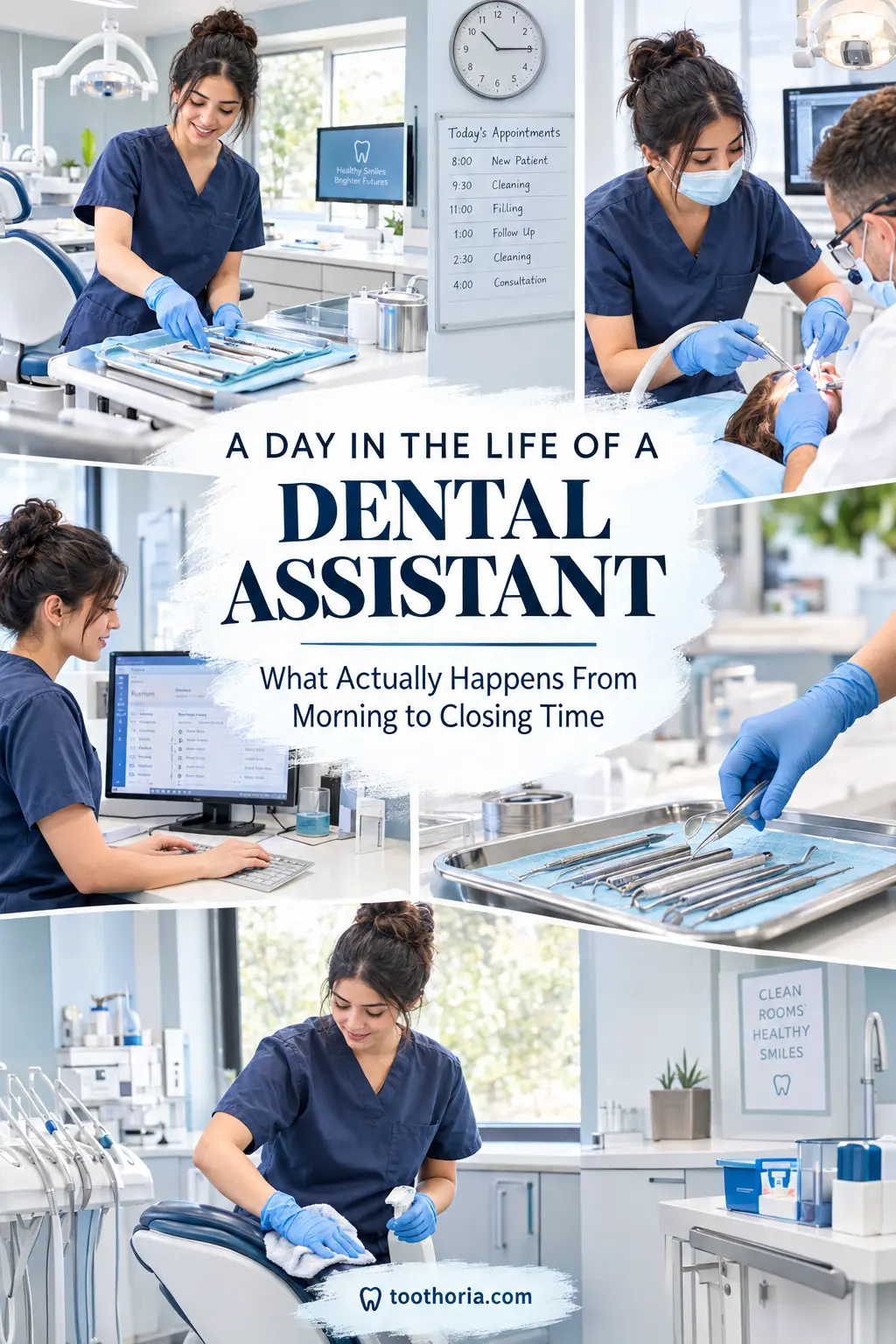
A Realistic Day, Hour by Hour
Here’s what a general practice day actually looks like. Anyone who has worked chairside will recognize the shape of it.
| Time | What’s happening |
| 7:30 a.m. | Unlock operatories, start autoclave cycles, check sterilization logs, scan the schedule |
| 8:00 a.m. | Morning huddle with the dentist and hygienist, flagging medical alerts and tricky cases |
| 8:15 a.m. | First patient seated, X-rays taken, medical history updated |
| 9:00 a.m. | Crown prep. Mix materials, take the impression, fabricate the temporary |
| 10:30 a.m. | Room turnover, chart the procedure, seat the next patient |
| 12:00 p.m. | Lunch, plus lab pickups and supply orders |
| 1:00 p.m. | Afternoon block of fillings, one extraction, one pediatric exam |
| 4:00 p.m. | Post-op calls to yesterday’s surgical patients |
| 5:00 p.m. | Final sterilization run, restock, shut down |
Notice how little of that is standing around. The pace is the single biggest surprise for people entering the field.
Your State Decides What You’re Allowed to Do
This is where most online articles get vague, and it matters more than anything else on this page.
There is no national job description. Each state’s dental board sets the scope of practice. Some states let trained assistants perform coronal polishing, apply sealants, place fluoride varnish, or apply topical anesthetic. Others restrict assistants strictly to supportive tasks.
If you want a real answer for yourself, look up your own State Board of Dental Examiners. A job posting from another state will mislead you.
Decoding the credentials
Dental Assistant (entry level). Many states require no license at all for basic assisting, and plenty of assistants learn on the job.
Registered Dental Assistant (RDA). A state-level registration. In states like California, RDAs can take endodontic cultures, place orthodontic separators, and perform coronal polishing.
Certified Dental Assistant (CDA). A national credential from the Dental Assisting National Board. It covers infection control, radiation health and safety, and chairside assisting.
Expanded Functions Dental Assistant (EFDA). The biggest pay lever in the entire field. Depending on the state, EFDAs may place and finish restorations, polish, or place sealants. It always requires extra training plus state authorization.
For program quality, look for training accredited by the Commission on Dental Accreditation. The American Dental Association keeps a useful overview of career pathways too.
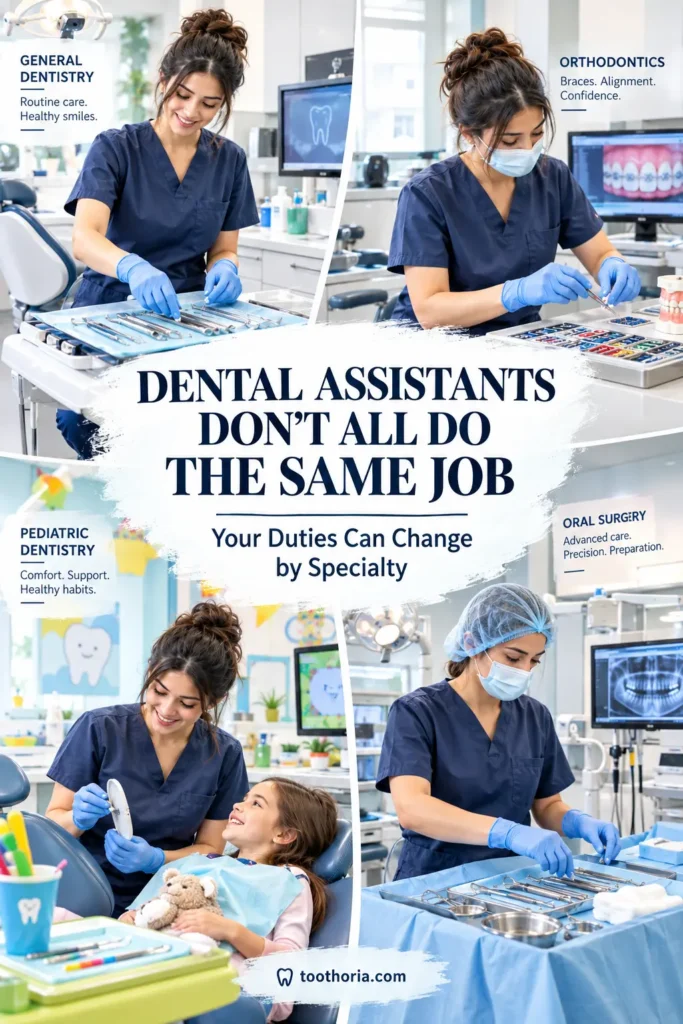
Duties Change a Lot by Specialty
The title stays the same. The work does not.
General dentistry. The broadest mix. Exams, fillings, crowns, extractions, plus front desk overflow.
Orthodontics. Placing separators, changing archwires and ligatures, taking progress photos and records. If you’re curious what patients face on that side, our breakdown of Invisalign vs braces and the cost of orthodontic braces covers the treatment decisions you’ll be explaining daily.
Oral surgery. Surgical setups, sterile technique, sedation monitoring support, and a lot of aftercare coaching. Assistants in these offices explain things to avoid after tooth extraction and what to eat after tooth extraction several times a day. Our guide to the 7 common types of oral surgery maps the procedures you’d be assisting.
Pediatric dentistry. Behavior guidance is half the job. You’ll apply fluoride, fit mouth guards, and educate parents constantly. If pedo interests you, start with modern kids dentistry and preventive dentistry for kids.
Endodontics. Irrigation, rubber dam isolation, microscope work, and managing rotary files.
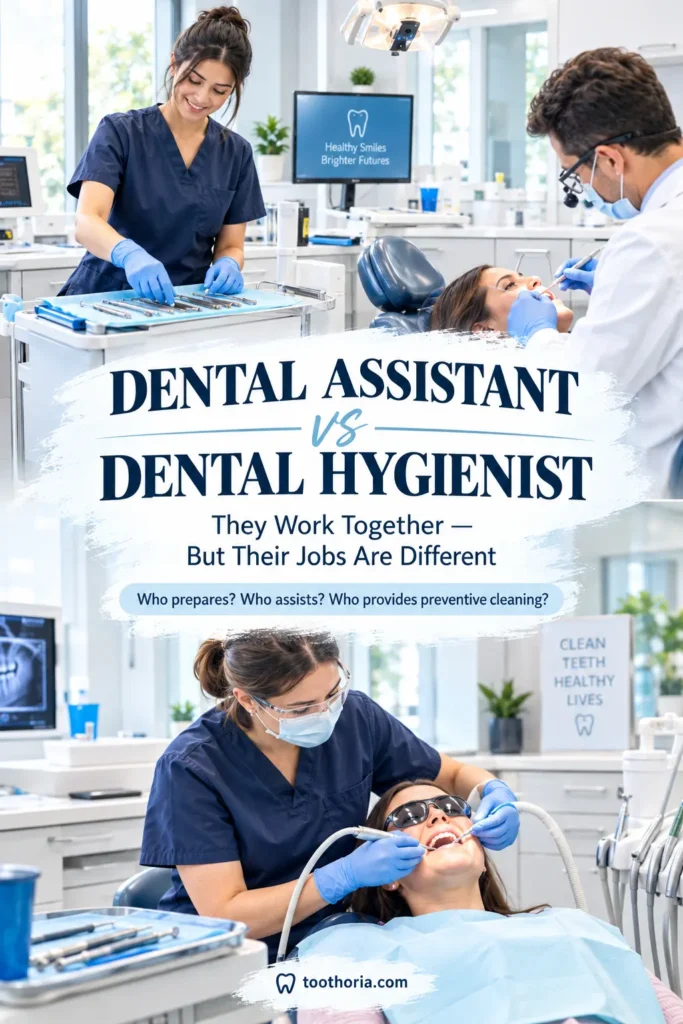
Dental Assistant vs Dental Hygienist
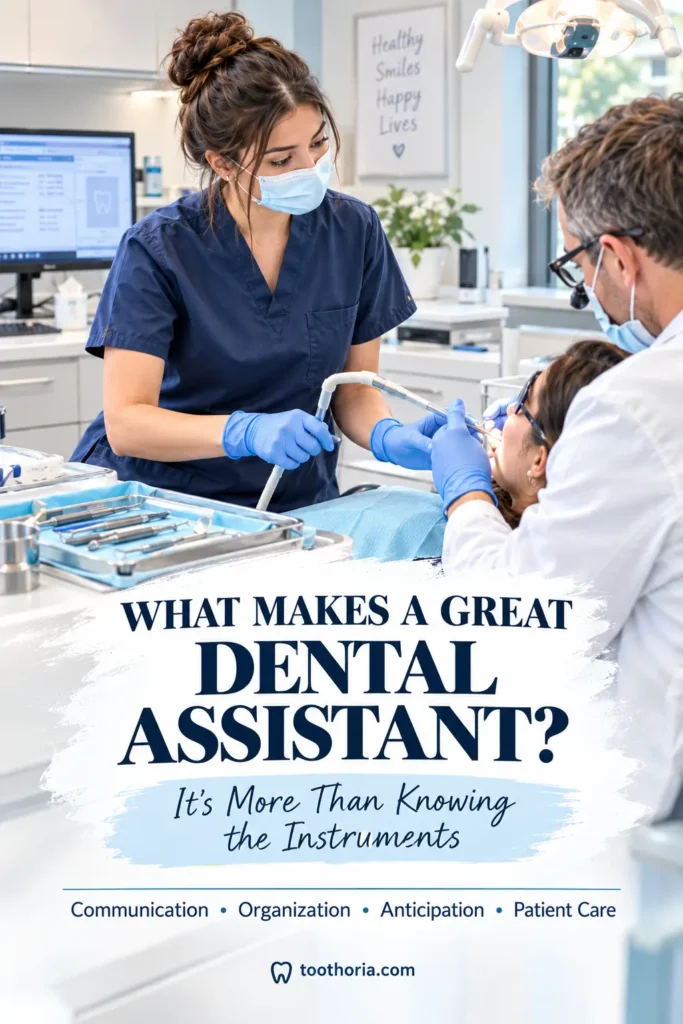
This confusion costs people years of career planning, so let’s settle it.
| Dental Assistant | Dental Hygienist | |
| Main focus | Supporting the dentist, running the office | Preventive care delivered directly |
| Core duties | Chairside assisting, sterilization, X-rays, records | Scaling, polishing, perio charting |
| Cleans teeth? | Usually no (polishing only where allowed) | Yes, it’s the core of the role |
| Education | Certificate, often under a year | Associate degree, about two years |
| Licensed? | Varies by state | Licensed in all states |
| 2025 US median pay | $48,070 | $98,100 |
Hygienists are the ones performing the deep cleanings patients ask about. If you want to understand that side of the chair, our patient guide to gum cleaning at the dentist and the article on calculus on teeth explain exactly what hygienists remove and why.
Plenty of assistants use the role as a bridge into hygiene. It’s one of the smartest moves in the field.
The Tech You’ll Actually Touch
Dental assisting has changed more in ten years than in the previous thirty.
You’ll work with digital sensors instead of film, intraoral cameras for patient education, and increasingly intraoral scanners that replace goopy alginate trays. Practice management software like Dentrix, Eaglesoft, or Open Dental will be open on your screen all day.
If you’re new to the field, skim our guides to dental technologies, intraoral scanners, and same-day dentistry. Offices running CEREC or chairside milling expect assistants to design and fit restorations the same visit. Teledentistry has also pulled assistants into virtual triage and screening calls, which barely existed a few years ago.
Skills That Separate Good Assistants From Great Ones
BLS highlights detail orientation, manual dexterity, interpersonal skills, listening, and organization. All true. Two more matter just as much in practice.
Anticipation. The best assistants know which instrument the dentist wants before the hand comes out. That skill is built, not taught.
Calm. A large share of patients are genuinely scared. Steadying them is part of the job even though it never appears in writing.
You’ll also become an unofficial oral health educator. Patients ask about bleeding gums, bad breath, and home care constantly. Having real answers ready from resources on gum disease stages, how to prevent cavities at home, and dental hygiene food tips makes you noticeably more valuable.
Common Mistakes New Assistants Make
Assuming national rules apply to your state. Someone reads that assistants take X-rays, moves to a new state, and discovers they need a separate radiography certification first. Check before you move.
Skipping accreditation. Cheap non-CODA programs exist. They leave graduates stuck when they try to sit for the CDA exam.
Ignoring ergonomics early. Neck and wrist problems are the top reason assistants leave the field. Set your stool height correctly from week one.
Staying entry level too long. Base assisting pay plateaus. Expanded functions, radiography certification, or a specialty move are what raise it.
Treating admin work as beneath you. The assistants who understand insurance coding become office managers. That path pays well and saves your back.
Where Assistants Work and What They Earn
Dental assistants held about 388,600 jobs in 2025, and roughly 91% of those were in dentists’ offices. The rest sit in physicians’ offices, government clinics, dental schools, community health centers, and hospital dental departments.
Median pay was $48,070 per year in May 2025, around $23.11 per hour. The bottom 10% earned under $37,130 and the top 10% cleared $62,250. Government roles paid the most at a $55,270 median.
Employment is projected to grow 7% from 2025 to 2035, much faster than the 3% average across all occupations, with roughly 53,000 openings per year.
How to Get Started, Step by Step
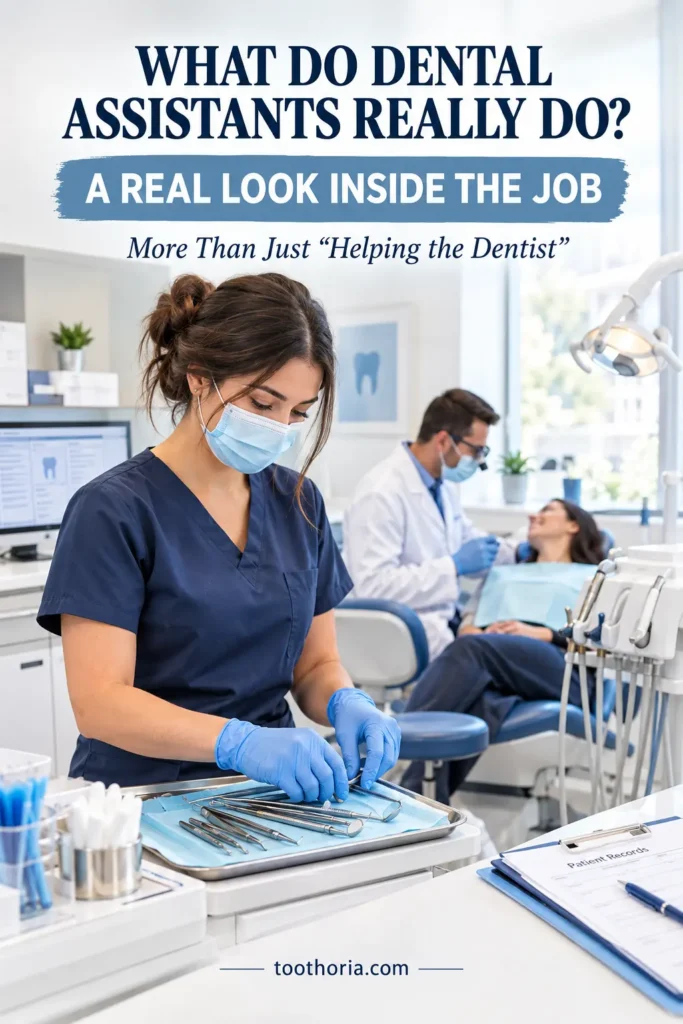
- Check your state board first. Requirements vary enormously. This single step saves months.
- Pick a CODA-accredited program. Most run about a year and lead to a certificate or diploma.
- Get CPR certified. Nearly every certification route requires it.
- Add radiography certification if your state requires it separately.
- Sit for the CDA through DANB once eligible. It travels across state lines better than a state registration.
- Shadow before you enroll. One full day in an office tells you more than any brochure.
- Plan your next step early. Expanded functions, a specialty, office management, or hygiene school.
The Honest Trade-Offs
The upside is real. You can be working in under a year, the training cost is low compared with most healthcare paths, demand is steady nationwide, and part-time and temp assisting options are everywhere.
The downside is also real. It’s physically demanding. Long hours standing in awkward postures wear on your back, neck, and wrists. Pay plateaus faster than most clinical roles unless you expand your credentials. You’ll absorb a steady stream of patient anxiety. And in small offices, “other duties as assigned” stretches a long way.
Outside the United States
If you’re reading from elsewhere, the terminology shifts. In the United Kingdom the equivalent is a dental nurse, registered with the General Dental Council. Canada uses Level I and Level II dental assistants, regulated provincially, with Level II covering intraoral duties. Australia uses dental assistant, with a Certificate III or IV as the standard qualification.
Frequently Asked Questions
Do dental assistants clean teeth?
Usually no. Scaling belongs to the hygienist. Some states allow trained assistants to perform coronal polishing, which removes surface stain only.
Can dental assistants take X-rays?
In most states yes, with specific radiography training or certification.
How long does it take to become a dental assistant?
Typically under a year for a certificate. Some states allow on-the-job training with no program at all.
Do you need a degree?
No. A postsecondary nondegree award is the typical entry credential.
Is dental assisting a good career?
For fast entry into healthcare with steady demand, yes. For long-term earnings, most people expand into EFDA work, office management, or hygiene.
What is an expanded functions dental assistant?
An assistant credentialed to perform additional clinical procedures, often placing and finishing restorations. It requires extra training and state authorization, and it’s the most reliable pay increase available inside the role.
Final Thoughts
The next time you’re in the chair, watch the assistant instead of the dentist. Watch how the suction moves, how the tray gets rearranged mid procedure, how the room gets reset in four minutes flat. That’s the job.
So what do dental assistants do? They make everything else in the practice possible. If that kind of work appeals to you, pull up your state dental board’s scope of practice page today, then find one CODA-accredited program near you. Those two tabs are the entire first step.