
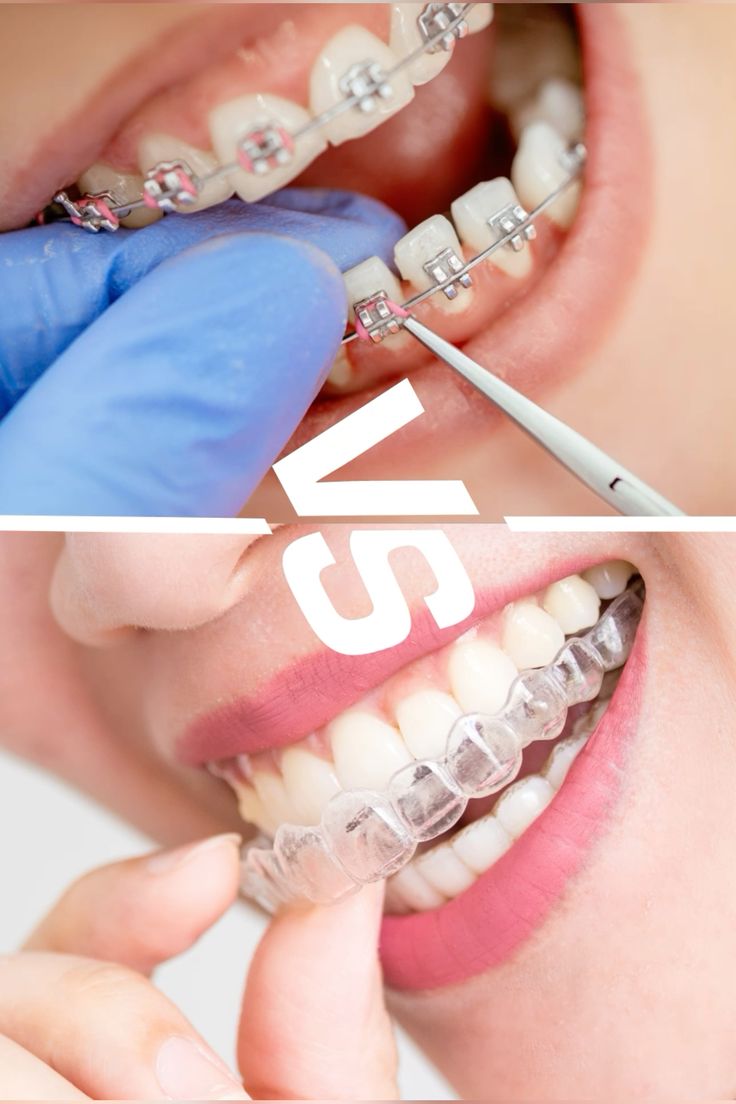
If you are weighing Invisalign vs braces and wondering which one is right for your teeth, your lifestyle, and your budget, you are not alone. This is one of the most searched orthodontic questions in 2026, and the answer is rarely as simple as “one is better than the other.” The right choice depends on your specific case, your daily habits, and how much you are willing to spend. This guide breaks down everything you need to know, including real costs, clinical differences, and which option delivers better value for most patients.
Invisalign vs Braces: Cost Comparison
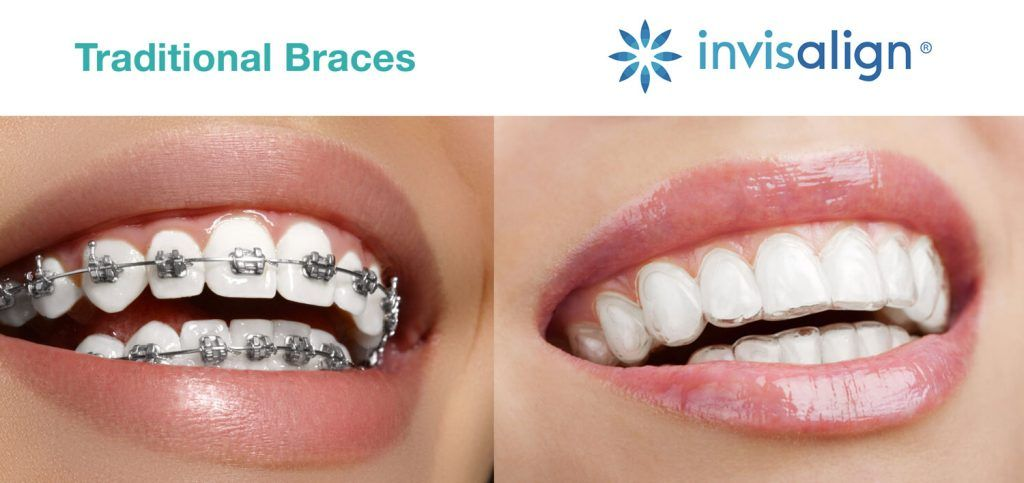
Cost is almost always the first question, so here is a direct side-by-side breakdown:
| Treatment Type | Average Cost | Best For |
| Metal braces | $3,000 to $7,000 | Complex cases, budget patients |
| Ceramic braces | $4,000 to $8,000 | Aesthetics at mid-range price |
| Lingual braces | $8,000 to $12,000 | Hidden treatment, highest cost |
| Invisalign clear aligners | $1,500 to $8,500 | Mild to moderate, adult patients |
| ClearCorrect | $2,000 to $8,000 | Invisalign alternative |
| Byte at-home aligners | $1,500 to $2,500 | Very mild cosmetic cases only |
For mild to moderate cases, Invisalign is often cheaper than braces or at least price-competitive. Ceramic braces and lingual braces both cost more than Invisalign on average, which surprises most patients who assume removable clear aligners are always the premium option.
The Invisalign cost for a simple Express case starts at $1,500. A full comprehensive plan for complex malocclusion correction runs $7,000 to $8,500. Traditional metal braces for the same complex case would cost $5,000 to $7,000. For straightforward adult cases involving mild tooth crowding or teeth spacing, Invisalign frequently wins on both cost and convenience.
Clinical Effectiveness: Which Works Better?
Both Invisalign and braces are FDA-cleared orthodontic treatments proven to correct misaligned teeth, overbite, underbite, crossbite, and malocclusion. The clinical difference lies in case complexity and patient compliance.
Where braces perform better:
- Severe malocclusion requiring significant bite correction
- Complex tooth rotation that needs precise three-dimensional force
- Cases involving significant overbite or underbite correction
- Patients who struggle with compliance since braces are fixed to teeth and work continuously
Where Invisalign performs better:
- Mild to moderate tooth crowding and teeth spacing issues
- Adult patients who prioritize aesthetics during treatment
- Cases where removability is important for professional or personal reasons
- Patients committed to wearing aligners 20 to 22 hours per day
A 2023 study published in the Journal of Clinical Orthodontics found that 92% of Invisalign patients reported satisfaction with their results when treatment was completed as planned. The key phrase is “as planned.” Invisalign outcomes depend heavily on patient discipline. Braces deliver consistent results regardless of whether the patient is diligent about their habits.
Treatment Time: Invisalign vs Braces
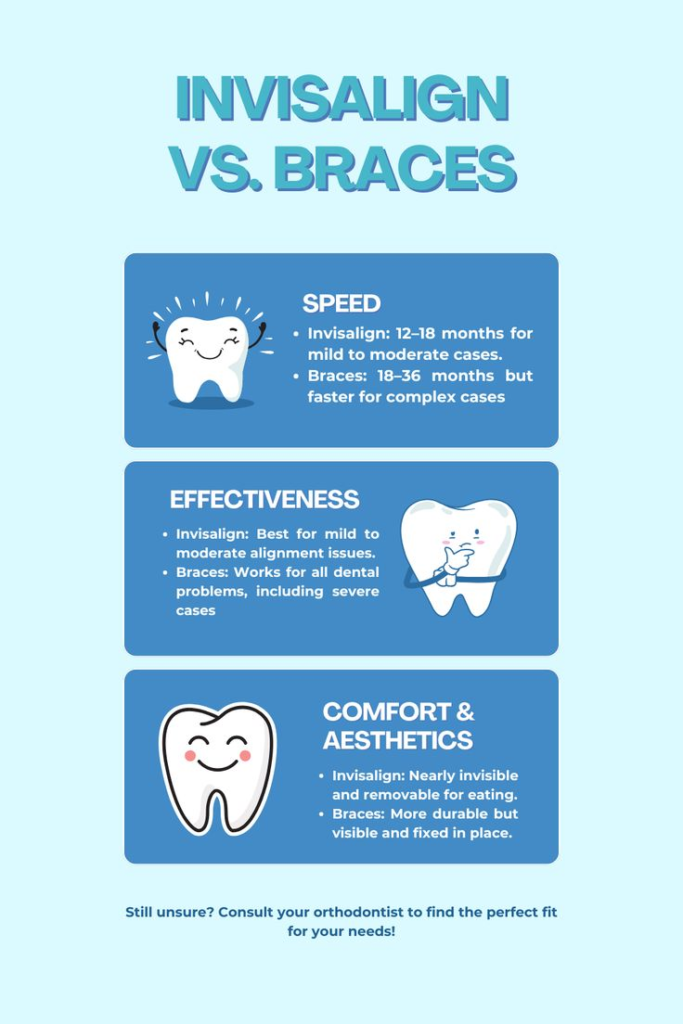
Treatment length is another major differentiator between the two options:
- Metal braces typically take 18 to 36 months for most cases
- Invisalign Lite treats mild cases in just 6 to 9 months
- Invisalign Moderate runs 12 to 18 months for average cases
- Invisalign Comprehensive takes 18 to 36 months for complex treatment
- Ceramic braces follow a similar timeline to metal braces at 18 to 36 months
For mild and moderate cases, Invisalign is often faster than traditional braces. For complex cases, treatment times are comparable. The critical variable with Invisalign is compliance. Patients who do not wear their custom aligner trays for the required 20 to 22 hours per day extend their treatment timeline and risk needing paid refinement rounds, adding $500 to $1,500 to their total Invisalign treatment cost.
Comfort and Lifestyle: The Real Differences
This is where Invisalign wins decisively for most adults.
Invisalign advantages:
- Virtually invisible during wear due to SmartTrack clear aligner material
- Fully removable for eating, drinking, brushing, and flossing
- No dietary restrictions since aligners come out at mealtimes
- Smoother surface means less irritation to cheeks and gums
- Fewer in-office adjustment appointments needed
Braces advantages:
- No compliance required since they are fixed to teeth
- Better for patients who are likely to forget or lose removable aligners
- Generally more effective for complex bite correction and severe malocclusion
- Typically covered at the same rate as Invisalign under most PPO dental plans
For working adults who need discretion, Invisalign clear aligners offer a significant lifestyle advantage. For teenagers or patients who know they will struggle with wearing removable aligners consistently, braces may ultimately deliver better results at a lower total cost when refinement rounds are factored in.
Insurance Coverage: Is It the Same for Both?
Yes, in most cases. Most PPO dental plans cover Invisalign at the same rate as traditional metal braces under their lifetime orthodontic maximum of $1,000 to $3,500. Delta Dental, Cigna, Aetna, and Humana PPO plans generally apply orthodontic benefits equally to both treatment types.
The key is ensuring your certified Invisalign provider or board-certified orthodontist submits the insurance claim correctly as orthodontic treatment rather than a cosmetic procedure. A simple billing error can cost you hundreds of dollars in uncovered expenses.
Both treatments are also FSA eligible and HSA eligible under IRS guidelines. With a 2026 FSA limit of $3,200 and HSA limit of $4,300, using pre-tax dollars for either braces or Invisalign reduces your effective out-of-pocket cost by 20 to 35% depending on your federal tax bracket.
Invisalign vs Braces: Which Should You Choose?
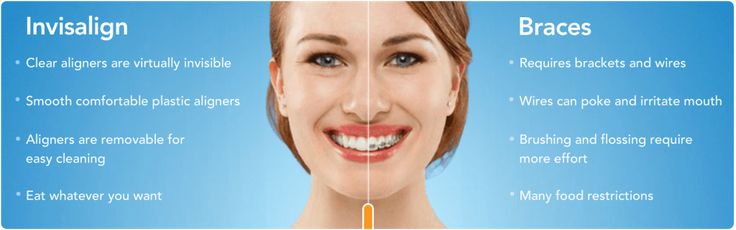
Here is a simple decision framework:
Choose Invisalign if:
- Your case involves mild to moderate tooth crowding, teeth spacing, or minor overbite
- You are an adult who values aesthetics and discretion during treatment
- You are fully committed to wearing aligners 20 to 22 hours daily
- You want fewer in-office visits and more flexibility
Choose braces if:
- Your case involves severe malocclusion, significant underbite, crossbite, or complex bite correction
- You are treating a teenager who may struggle with aligner compliance
- Your budget is tight and metal braces offer a lower quote for your specific case
- You want a fixed treatment that works regardless of daily habits
Frequently Asked Questions
1. Is Invisalign more expensive than braces?
Not always. For mild to moderate cases, Invisalign is often price-competitive with metal braces, ranging from $1,500 to $8,500. Ceramic and lingual braces typically cost more than Invisalign, making clear aligners the better value for most adult patients.
2. Which is faster, Invisalign or braces?
For mild to moderate cases, Invisalign is generally faster, with Invisalign Lite completing treatment in just 6 to 9 months. For complex malocclusion or severe bite correction, both treatments take a comparable 18 to 36 months depending on case severity.
3. Does insurance cover Invisalign the same as braces?
Yes. Most PPO dental plans including Delta Dental, Cigna, and Aetna cover Invisalign at the same rate as traditional braces under their lifetime orthodontic maximum of $1,000 to $3,500. Always confirm your provider submits the claim as orthodontic treatment, not cosmetic.
4. Can I switch from braces to Invisalign mid-treatment?
Yes, but it depends on your case complexity and how much treatment remains. A board-certified orthodontist can assess whether switching is clinically appropriate. Switching mid-treatment may involve additional costs for new 3D digital scans and a fresh ClinCheck digital treatment plan.
5. Which is better for teens, Invisalign or braces?
For teens, braces are often the safer choice since they are fixed and work regardless of compliance. However, Invisalign Teen includes up to 6 free replacement aligner trays and eruption tabs for still-growing teeth, making it a strong option for disciplined teenagers whose parents want a more discreet treatment solution.
Final Thoughts
The Invisalign vs braces debate does not have a universal winner. For mild to moderate cases in adult patients, Invisalign delivers comparable or superior results at a competitive cost with significantly better lifestyle flexibility. For complex cases or compliance-challenged patients, traditional braces remain the more reliable and often more cost-effective choice.
The most important step is getting a free consultation with a board-certified orthodontist who can evaluate your specific case, show you a ClinCheck digital treatment plan for Invisalign, and give you itemized quotes for both options side by side. Armed with that information, the right choice becomes clear.