
A toothache that will not go away is not something to sleep on. Many people wonder: how long until a tooth infection kills you? The answer is faster than most people expect.
A severe, untreated tooth infection can become life-threatening within 3 days in extreme cases. In most cases, dangerous complications develop within 1 to 4 weeks of the infection being fully ignored.
Death from a dental infection is rare, but it is real. Thousands of people are hospitalized every year from untreated dental abscesses. Some do not survive. The difference between a safe outcome and a fatal one almost always comes down to how quickly you act.
This complete guide covers the full day-by-day timeline, every critical tooth infection symptom, the difference between swollen gums vs abscess, whether a gum infection can kill you, the sinus connection, and exactly when to go to the emergency room.
How Long Until a Tooth Infection Kills You? The Direct Answer
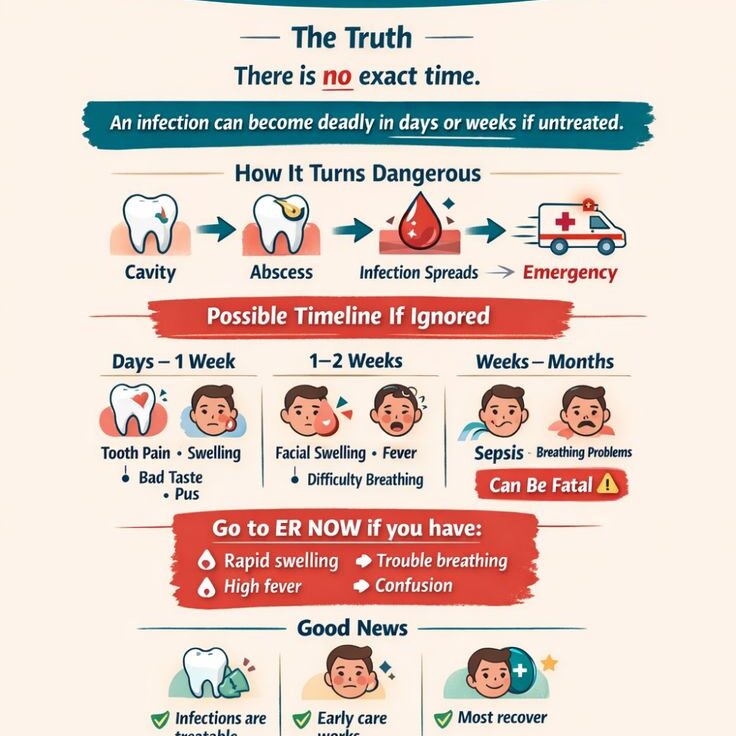
How long until a tooth infection kills you depends on three things:
- Where the infection spreads: jaw, neck, bloodstream, or airway
- Your immune health: diabetes, cancer treatment, or HIV accelerate the timeline
- Whether you get treatment at all
For a healthy adult, complications are unlikely in the first few days. For someone with diabetes or a weakened immune system, the danger window is much shorter.
The key takeaway: a tooth infection can kill you. It has killed people. And it happens faster than most patients believe when they first feel that dull throb in their jaw.
The Day-by-Day Timeline of a Tooth Infection
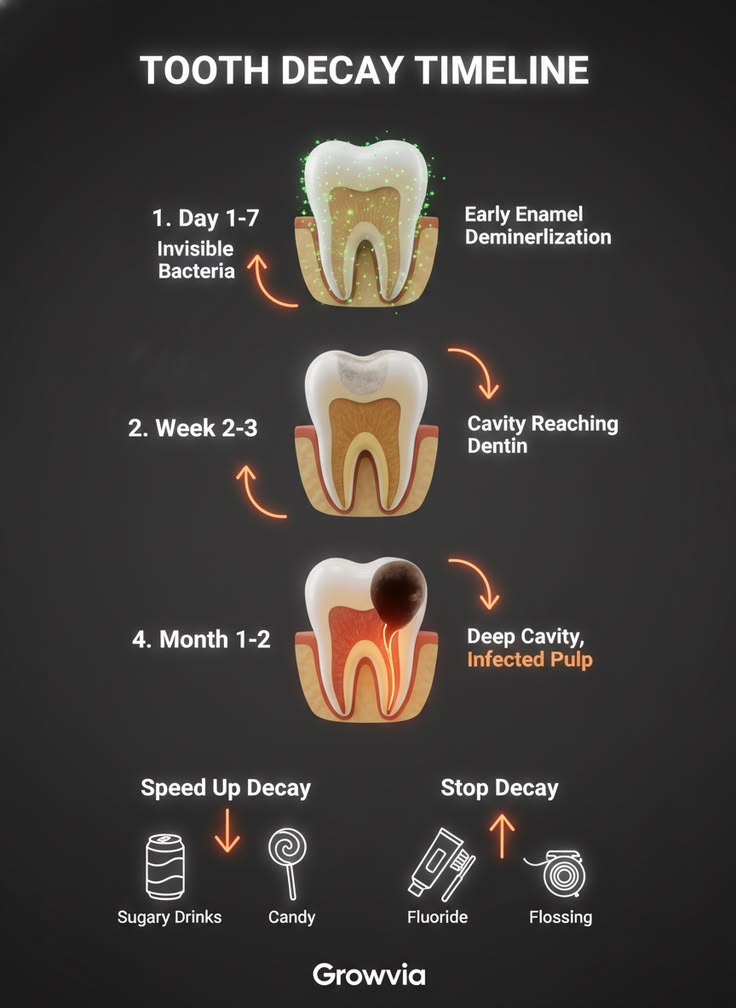
Hours 1 to 48: Infection Inside the Tooth
The bacteria have entered the dental pulp, the soft tissue at the center of your tooth containing nerves and blood vessels.
What you feel:
- Dull, throbbing, or sharp tooth pain
- Sensitivity to hot and cold that lingers
- Mild discomfort when biting
How dangerous is it? At this stage, how long until a tooth infection kills you is still weeks away. A dentist can resolve this quickly with a root canal or antibiotics. This is the easiest and cheapest stage to treat.
Days 3 to 7: Abscess Formation
Pus builds up at the root tip or in the surrounding gum tissue, forming a dental abscess.
What you feel:
- A visible raised bump on the gum
- Foul or salty taste in your mouth
- Intense pain radiating to the jaw or ear
- Persistent bad breath
- Swelling starting around the tooth
Most people visit a dentist during this stage because the pain becomes severe. This is still a manageable stage with proper dental treatment.
Days 7 to 14: Spread to the Jaw, Face, and Neck
This is where things become genuinely dangerous. Bacteria travel through tissue planes connecting the jaw, face, and neck at a faster rate than most patients realize.
What you may experience:
- Significant facial swelling on one side
- Difficulty fully opening your mouth
- Fever developing or worsening
- Painful, swollen lymph nodes in the neck
- Pain when swallowing
- General feeling of being seriously ill
At this stage, a regular dental appointment is often no longer enough. Emergency room care, IV antibiotics, and surgical drainage become necessary. This is the stage where the answer to how long until a tooth infection kills you starts being measured in days.
Beyond 2 Weeks: Life-Threatening Complications
If the infection still receives no treatment past the two-week mark, it can spread to:
- The brain (cerebral abscess)
- The chest cavity (mediastinitis)
- The bloodstream (sepsis)
- The airway (Ludwig’s Angina)
Each of these complications carries a significant mortality rate even with full hospital treatment.
The Deadly Complications of an Untreated Tooth Infection
Understanding the specific complications helps answer how long until a tooth infection kills you for each worst-case outcome.
Ludwig’s Angina A rapidly spreading bacterial infection of the floor of the mouth and neck. It can develop within 2 to 4 days of an untreated lower molar abscess. Once the airway is compressed, death from suffocation can occur within hours without emergency intervention.
Sepsis When oral bacteria enter the bloodstream and trigger a whole-body inflammatory response. Dental sepsis can develop within 2 to 7 days of the infection spreading. Septic shock has a mortality rate of 30 to 50 percent even with intensive care.
Brain Abscess Rare but documented. Bacteria travel via venous pathways from the jaw to the brain over days to weeks. It requires emergency neurosurgery and carries significant mortality risk.
Descending Necrotizing Mediastinitis Infection tracks down the neck into the chest cavity around the heart and lungs. Mortality rate exceeds 40 percent even with aggressive surgical treatment.
Tooth Infection Symptoms: Early to Life-Threatening
Catching tooth infection symptoms early is the single most effective way to prevent a dental infection from turning deadly.
Early symptoms:
- Persistent toothache (constant or triggered by temperature)
- Sensitivity to hot or cold that does not go away quickly
- Pain when biting or applying pressure
- Mild gum tenderness around one tooth
Moderate symptoms:
- Visible bump or pimple on the gum
- Foul or salty taste when the abscess drains
- Bad breath that brushing does not fix
- Facial swelling on one side
- Fever above 38°C or 100.4°F
Emergency symptoms — go to the ER immediately:
- Swelling of the face, jaw, or neck that is spreading visibly
- Any difficulty swallowing or breathing
- Inability to open the mouth more than two finger-widths
- Confusion or altered thinking
- Racing heart rate
- Fever above 39°C or 102°F not responding to medication
- Extreme sudden fatigue or feeling severely ill
These emergency tooth infection symptoms mean the infection has left the tooth. You are no longer in dental territory. You are in emergency medical territory.
Tooth Infection Symptoms Spreading Through the Body
When tooth infection symptoms extend beyond the mouth, bacteria have gone systemic. Watch for:
- Swollen lymph nodes under the jaw or in the neck
- Ear pain or jaw joint pain
- Severe persistent headache
- Stiff or painful neck
- Eye swelling or vision changes
- Chest pain or shortness of breath
Any of these combined with tooth pain require immediate emergency room evaluation.
Can a Gum Infection Kill You?
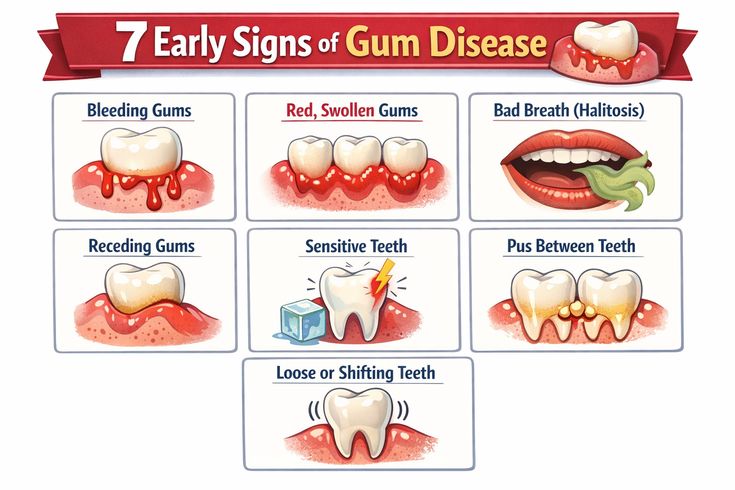
Yes. Can a gum infection kill you? Absolutely, through the same pathways as a tooth abscess.
Gum infections introduce bacteria directly into the bloodstream through highly vascular gum tissue. Research has linked chronic gum infections to:
- Heart disease
- Stroke
- Bacterial endocarditis (mortality rate of 20 to 30 percent even with treatment)
An acute periodontal abscess can spread to the jawbone and deeper tissue spaces. Ludwig’s Angina, sepsis, and mediastinitis are all documented outcomes of severely neglected gum infections.
Can a gum infection kill you the same way a tooth abscess can? Yes. The danger is identical once the infection reaches the spreading stage.
Swollen Gums vs Abscess: The Critical Difference
Confusing swollen gums vs abscess is one of the most common reasons patients wait too long for care.
| Feature | Swollen Gums | Dental Abscess |
| Location | Generalized, multiple teeth | Localized to one tooth or area |
| Appearance | Puffy, red, diffuse | Raised, firm or fluid-filled bump |
| Cause | Gingivitis, irritation, plaque | Bacterial infection with pus |
| Taste/Smell | Mild bad breath | Distinctly foul taste when draining |
| Treatment needed | Improved hygiene, cleaning | Immediate dental treatment |
| Does it resolve alone? | Sometimes improves | Never resolves without treatment |
If you have a raised lump on your gum near one painful tooth combined with fever, that is an abscess. It will not go away on its own. Waiting on swollen gums vs abscess confusion has cost people their lives.
Can a Sinus Infection Cause Tooth Pain?
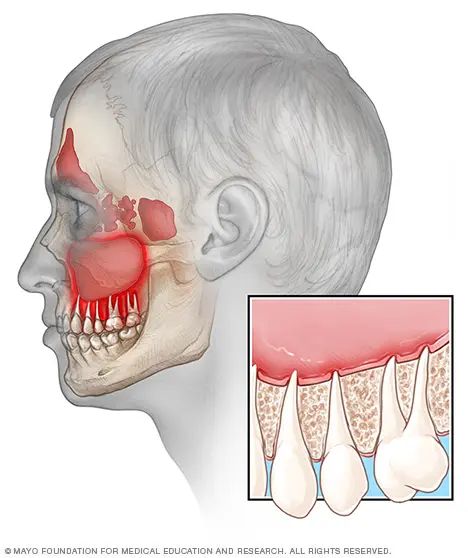
Yes, and this two-way connection sends thousands of patients down the wrong treatment path every year.
Why it happens: The roots of your upper molars and premolars sit directly beneath the floor of the maxillary sinus. An infected upper tooth can cause sinus-like symptoms. A genuine sinus infection can cause aching in multiple upper teeth.
How to tell the difference:
- If multiple upper teeth ache with no specific sensitivity to cold or biting, a sinus infection may be the cause
- If one specific tooth is exquisitely painful, sensitive to cold, and hurts when tapped individually, the tooth is the source
Why this matters for your safety: When a dental infection causing sinus symptoms gets treated only with nasal decongestants and sinus medication, the bad tooth continues to worsen silently. The infection advances along the dangerous timeline while symptoms appear to temporarily improve. Can a sinus infection cause tooth pain? Yes. But a bad tooth causing sinus-like symptoms is equally common and far more dangerous when missed.
If you have persistent one-sided tooth pain and sinus symptoms simultaneously, see both a dentist and a physician. Do not assume it is one or the other.
Bad Tooth: How Fast Can It Become Dangerous?

A bad tooth is any tooth with:
- Severe untreated decay reaching the pulp
- A crack or fracture with exposed inner tissue
- A failed or broken dental restoration
- An existing abscess at any stage
Every bad tooth is an active bacterial reservoir. The progression from a neglected bad tooth to a life-threatening infection can happen within days under the right conditions. A single bite on a hard piece of food can fracture a severely decayed tooth and introduce bacteria to the pulp almost instantly, triggering abscess formation within days.
People who avoid treating a known bad tooth because of dental anxiety, financial barriers, or believing it will settle down on its own are the most vulnerable to reaching the worst end of the timeline for how long until a tooth infection kills you.
A bad tooth is never just a bad tooth. It is an infection waiting for the right conditions to spread.
Who Is at Highest Risk?
Not everyone faces the same timeline. These groups face accelerated and more deadly infection progression:
- Diabetics: impaired immunity and poor circulation allow faster spread
- Cancer patients on chemotherapy: severely suppressed immune response
- HIV/AIDS patients: reduced ability to fight bacterial infection
- Organ transplant recipients: immunosuppressant medications lower defenses
- Older adults: weakened immune reserves and multiple health conditions
- Heart valve disease patients: risk of fatal bacterial endocarditis
- Long-term steroid users: suppressed immune function
- Children: infections can escalate quickly and signs are easy to miss
A Warning for Parents
The death of 12-year-old Deamonte Driver in 2007 from a brain abscess originating in an untreated tooth remains the most cited case in dental public health. Facial swelling, fever, or difficulty eating in a child with tooth pain is always a same-day emergency. Never wait overnight.
How Dentists Treat a Tooth Infection

The reassuring counterpoint to everything above is that tooth infections are nearly always completely curable when treated in time.
Root Canal Therapy Removes infected pulp tissue, cleans the canals, and seals the tooth. Success rate above 90 percent. Completely eliminates the infection source.
Incision and Drainage A small cut allows the abscess to drain, relieving dangerous pressure and removing the bacterial pocket. Usually combined with antibiotics.
Tooth Extraction When the tooth cannot be saved, removal eliminates the infection entirely. In hospital emergency settings, extraction combined with IV antibiotics is often the fastest life-saving path.
Antibiotics Support treatment but can never replace it. Antibiotics suppress the infection temporarily but cannot eliminate it without removing the infected source. Using antibiotics alone is one of the most common reasons patients return to emergency rooms with a more advanced and more dangerous infection.
Emergency Signs That Require the ER Right Now
Do not call a dentist. Do not wait until morning. Go to the emergency room immediately if you have any tooth infection symptoms plus:
- Swelling of the face or neck spreading over hours
- Any difficulty breathing
- Any difficulty swallowing
- Inability to open your mouth more than two finger-widths
- Confusion or disorientation
- Fever above 39°C or 102°F not responding to medication
- Rapid heart rate
- Feeling profoundly and suddenly very ill
At this point, how long until a tooth infection kills you is no longer a hypothetical question. It is an active emergency. Call emergency services if swelling enters the throat or breathing becomes difficult at all.
How to Prevent a Tooth Infection from Becoming Dangerous
Prevention is always better than emergency treatment. Follow these steps:
- Brush twice daily with fluoride toothpaste
- Floss at least once per day
- Attend dental checkups and cleanings every 6 months
- Treat cavities and broken teeth promptly, do not wait
- Wear a mouthguard during contact sports
- Manage diabetes and chronic conditions carefully
- Avoid tobacco in all forms
- Seek low-cost dental care through community health centers if cost is a barrier
The cost of treating a small cavity is always a fraction of emergency hospitalization for a spreading infection.
Frequently Asked Questions
How long can you live with an infected tooth?
Some people carry a low-grade tooth infection for months. But the infection can escalate suddenly and without predictable warning at any time, jumping from manageable to life-threatening within days.
Can you get sepsis from a tooth infection?
Yes. Dental sepsis is a documented medical condition. How long until a tooth infection kills you through sepsis can be as short as 72 hours from when bacteria enter the bloodstream to septic shock in severe cases.
How do you know if a tooth infection is in your bloodstream?
High fever, chills, rapid heart rate, confusion, and extreme fatigue that go beyond what a normal toothache would cause are the warning signs. This requires emergency room care immediately.
Can a tooth infection kill you overnight?
Instant death is rare, but overnight deterioration to a life-threatening condition is genuinely possible, especially if Ludwig’s Angina causes sudden airway compromise. Emergency symptoms are always same-day crises.
Can a sinus infection cause tooth pain on its own?
Yes. Maxillary sinusitis creates pressure directly onto upper tooth roots. But always confirm with a dentist that the tooth itself is not the actual source.
Conclusion
How long until a tooth infection kills you is not a question designed to frighten you. It is a question with a medically documented answer that could save your life. The timeline is clear: days to weeks without treatment, faster for high-risk individuals, and potentially within hours once complications like Ludwig’s Angina or sepsis begin.
Every stage of a tooth infection, from a visibly bad tooth to a fully formed abscess with swollen gums, is completely treatable when addressed in time. Whether you are trying to understand tooth infection symptoms, working out the difference between swollen gums vs abscess, wondering whether can a gum infection kill you, or connecting can a sinus infection cause tooth pain to your current situation, the answer always points in one direction. See a dentist today. Go to the ER if serious symptoms are already present. Never wait on a bad tooth that is causing you pain. Your life is worth more than the fear of a dental appointment.