
Getting dental implants is a big investment in your smile and your health. But here is something many patients do not expect: once the implants are in, the work is not over. How you clean around them every single day decides whether they last ten years or a lifetime. And what is the biggest thing that most implant patients skip? Flossing.
If you have ever wondered whether you can floss dental implants, how to do it without hurting the gums, or which products actually work, this guide covers everything. This is the same advice we give to patients at the chair, explained in plain words so you can start doing it right today.
Why You Must Floss Dental Implants Every Day
A natural tooth has a root. That root sits inside the bone and has a built-in defense system where the gum fibers attach tightly around it. An implant does not have that. The gum sits around an implant more loosely, which means bacteria can sneak in underneath and build up in ways that brushing alone will never catch.
When bacteria collect around the base of an implant, they trigger an infection called peri-implantitis. This is the implant version of gum disease, and it is the number one reason implants fail. It causes bone loss around the implant post, and once that bone is gone, the implant becomes loose and eventually has to come out.
The good news is that peri-implantitis is almost entirely preventable. Regular flossing for dental implants removes the plaque and food debris from the tight space between the crown and the gum before bacteria can take hold. That one daily habit protects your bone, your gum tissue, and the peri-implant seal, which is the healthy zone of tissue that keeps infection out.
Should I Be Able to Floss Under My Implant?
This is one of the most common questions patients ask, and the answer is yes. You should be able to pass floss gently beneath the implant crown and along both sides of the abutment. If you can’t get floss through or feel a hard stop, tell your dentist at your next visit.
However, if floss goes in deeply and you still notice an odor or the tissue bleeds every time, that is a sign something needs attention. We will cover both of those situations below.
How to Floss Dental Implants: Step-by-Step
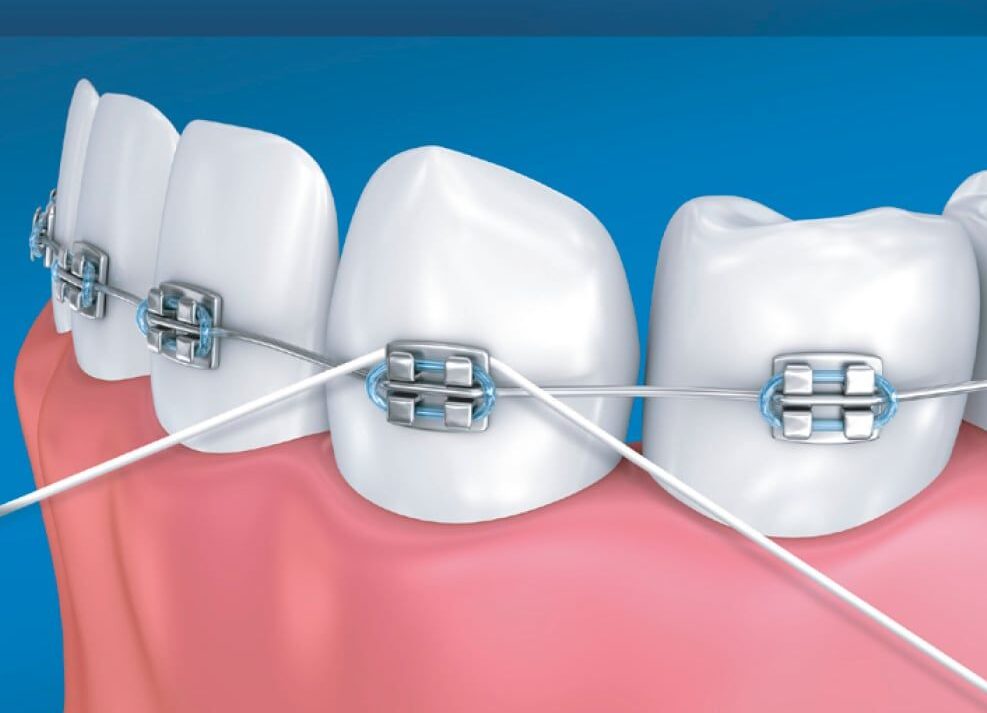
Flossing around dental implants is slightly different from flossing natural teeth. Regular floss is harder to thread under the crown, and snapping it aggressively down into the gum like you would with a natural tooth can irritate the soft tissue around the implant. Here is the correct method.
Step 1: Choose the Right Floss
Do not start with regular waxed floss. Use a floss designed for implants, bridges, or fixed dental work. Super floss for dental implants is one of the most widely recommended options because it has three sections: a stiff threader end, a spongy middle section, and regular floss. The stiff end threads under the crown easily, and the spongy section wipes the abutment clean.
Step 2: Thread the Floss Under the Crown
Take the stiff threader end of your super floss or implant floss and pass it gently through the gap between the implant crown and the neighboring tooth, or under the gum contact point if there is no adjacent tooth. Go slowly. Do not force it.
Step 3: Wrap It in a C-Shape
Once the floss is through, wrap it around the base of the implant in a C-shape, hugging the abutment. This is the same motion you would use around a natural tooth, just done more carefully.
Step 4: Slide Up and Down Gently
Using the spongy segment, slide the floss gently up and down along both sides of the implant. Go just slightly below the gumline where the tissue meets the crown. Do not press hard or jerk the floss.
Step 5: Clean Both Sides
Move the floss to the other side of the implant and repeat. Clean the surface of the abutment facing the cheek and the surface facing the tongue or palate.
Step 6: Rinse Well
Pull the floss out gently, then rinse with water or an antimicrobial mouth rinse. This washes away the loosened debris and bacteria.
Do this procedure once a day, every day. Nighttime is the best time because bacteria are most active while you sleep.
How to Floss All-on-4 Dental Implants
Flossing the All-on-4 dental implants is a different challenge because there is no individual crown to thread around. Instead, you have a full arch prosthesis that sits on four implant posts. The goal is to clean the long undersurface of the bridge where it rests close to or touches the gum tissue.
Use a Floss Threader or Super Floss
Cut a long piece of Super Floss for dental implants, or use a TePe Bridge and Implant Floss strip. Thread the stiff end under the prosthesis from one end of the arch to the other. Use the spongy section to gently wipe along the underside of the bridge and the gum beneath it.
Use a Water Flosser as Your Primary Tool
For most All-on-4 patients, a water flosser for dental implants becomes the main cleaning tool because it reaches beneath the full arch prosthesis, where traditional floss cannot go. Set it to a medium pressure setting. Do not use the highest pressure, which can irritate healing tissue or push debris further in.
Aim the water flosser tip at a 45-degree angle toward the gumline and trace it along the entire undersurface of the bridge from front to back on both sides. This is the single best way to clean under full arch implants every day.
Learn About Waterpik vs. Flossing.
Use an Interdental Brush for the sides.
Small interdental or proxy brushes can slide along the sides of the implant posts where they exit the gum. Use a size that fits snugly without forcing. These are especially useful for the spaces between posts where the arch prosthesis does not cover the gum.
Best Floss for Dental Implants
Not every type of floss works well around implants. Here is a breakdown of the best options, with honest notes on each.
Super Floss for Dental Implants
Oral-B Super Floss is the most well-known option and one of the most recommended. The built-in threader makes it simple to use without a separate threading tool, and the spongy segment cleans effectively around abutments. It works for single implants, bridges supported by implants, and partial arches.
TePe Bridge and Implant Floss
TePe Bridge and Implant Floss comes in pre-cut strips with a spongy texture that grips plaque well. The strips are wide enough to clean a broad surface area under bridge-style restorations and are gentle on gum tissue. Many hygienists recommend TePe Bridge and Implant Floss by name because of its consistent quality.
Proxysoft Bridge and Implant Dental Floss
Proxysoft dental floss for bridges and implants uses a unique looped design that makes threading much easier than standard super floss. The soft fiber wraps around the implant components without scratching the surface of zirconia or porcelain crowns. It is a good choice for patients who struggle with dexterity.
Thornton Dental Floss for Implants
Thornton Bridge and Implant Dental Floss is another brand that comes up often in clinical settings. It features a firm threader tip and a soft cleaning segment. It works well for people with fixed bridges, where getting floss started is the biggest challenge.
Curaprox Dental Floss Bridge Implant
Curaprox dental floss for bridge and implant care is thicker and softer than standard floss, which makes it kind to the tissue around implants. It does not shred easily, which matters because shredded floss can leave fibers behind under the crown and cause irritation.
X Floss for Implants
“X floss for implants” refers to a category of expandable or textured floss products that widen on contact with moisture. The expanded texture increases the surface area cleaned with each pass, which is helpful around wide implant abutments.
Best Water Flosser for Dental Implants
A water flosser is not a replacement for dental floss with dental implants, but it is an excellent companion tool. For All-on-4 patients or anyone with multiple implants, it may become the cornerstone of daily hygiene.
Look for a water flosser that offers adjustable pressure settings, comes with a specialized implant tip or pocket tip, and has a reservoir large enough to clean a full arch without constant refilling. The implant tip is a narrow tip that directs water at a precise angle to flush the peri-implant sulcus, the small channel between the gum and the crown.
Brands with implant-specific tips include Waterpik, Philips Sonicare, and Panasonic. When using any water flosser with dental implants, always start on the lowest pressure and work up slowly. High pressure directed straight into healing or sensitive tissue can cause damage.
Can you use a water flosser with dental implants? Absolutely yes, and many implant dentists actively encourage it, especially for patients who struggle with traditional flossing techniques.
What to Do If Your Dental Implant Smells When Flossing
If your dental implant smells when flossing, bacteria have built up in the space between the crown and the gum. This almost always means one of two things: either the cleaning routine is not thorough enough to reach that area, or the crown fit has a small gap that traps debris.
Try improving your flossing technique using Super Floss or TePe Bridge and Implant Floss, and add a water flosser to your routine. Use an antimicrobial mouth rinse, such as a chlorhexidine rinse, for a short period. If the smell continues after two weeks of excellent hygiene, see your dentist. The crown may need to be checked for fit, or there could be early peri-implantitis forming that needs professional treatment.
Learn About Perio Breathe
Bleeding When Flossing a Dental Implant
Some light spotting is normal for a few days when you first start flossing an area that has not been cleaned regularly. But ongoing bleeding when flossing a dental implant is a warning sign, not something to ignore.
Dental implant bleeding when flossing usually means the tissue around the implant is inflamed. The issue can be from inadequate cleaning, but it can also be an early sign of peri-implant mucositis, the reversible early stage of implant gum disease. Caught early, the condition responds well to improved home care and a professional cleaning. Left alone, it progresses to bone loss.
If your implant bleeds every time you floss for more than two weeks despite excellent technique, book an appointment with your dentist or hygienist.
Dental Implant Brushing and Flossing: The Full Daily Routine
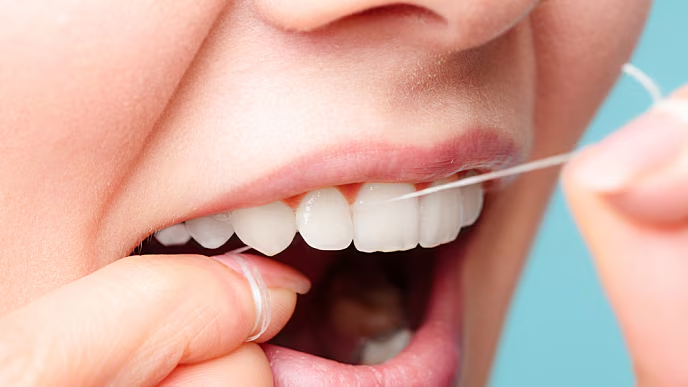
Flossing is only part of the picture. Here is what a complete daily implant care routine looks like.
Morning: Brush with a soft-bristle toothbrush, angled at 45 degrees toward the gumline around the implant crown. Use a non-abrasive toothpaste. Abrasive pastes scratch the surface of crowns and abutments over time.
After meals: Rinse with water or swish with a gentle antimicrobial rinse to dislodge loose food particles.
Evening: Floss dental implants using Super Floss, TePe Bridge and Implant Floss, or your chosen dental floss for implants. Follow with a water flosser if you have one. Finish with a fluoride or antibacterial mouth rinse.
Every six months: This is a professional hygiene appointment specifically for cleaning implants. Hygienists use instruments safe for implant surfaces to remove hardened calculus that home tools cannot touch.
Dental Implant Floss Screw Exposed: What It Means
Some patients notice when flossing dental implants that they can feel what seems like a small access hole or rough spot on the top of the implant crown. This is usually the screw access channel, which is the small hole used to tighten the crown onto the abutment. It should normally be sealed with a composite filling material.
If the screw feels rough when you floss or touch it with your tongue, the seal may be cracked or worn. This allows bacteria direct access to the inside of the implant. Contact your dentist to have it resealed. It is a simple fix done quickly in the chair.
Learn Dental Implant Cost
Conclusion
Learning how to properly floss dental implants is one of the most important things you can do to protect your investment and your oral health. The right floss, the right technique, and a consistent daily habit keep the peri-implant seal intact, prevent peri-implantitis, and help your implants last for decades.
Whether you have a single implant crown or a full All-on-4 arch, there is a tool and a method that works for your situation. Super floss for dental implants, TePe Bridge and Implant Floss, Proxysoft, and a reliable water flosser for dental implants give you everything you need. Use them every day, and your gums and bone tissue will stay healthy long after your final crown is placed.
Frequently Asked Questions
How often should I floss dental implants?
Once a day, every day. Nighttime is best because it clears bacteria before sleep.
What is the best floss for dental implants?
Super Floss for dental implants and TePe Bridge and Implant Floss are the top choices most dentists recommend.
Can I use a water flosser with dental implants?
Yes. A water flosser is an excellent tool, especially for All-on-4 implants. Use a medium pressure setting and an implant tip.
My dental implant smells when flossing. What should I do?
Improve your flossing routine and add a water flosser. If the smell persists beyond two weeks, see your dentist to check for peri-implantitis.
Is bleeding when flossing a dental implant normal?
Brief initial spotting can happen when you first start. Ongoing bleeding is a warning sign and needs professional evaluation.